
“I Am Holding You in My Mind and Heart” are the Most Profound Words Humans Can Say to Traumatized Dogs
By Dr. Laura Donaldson, PhD.
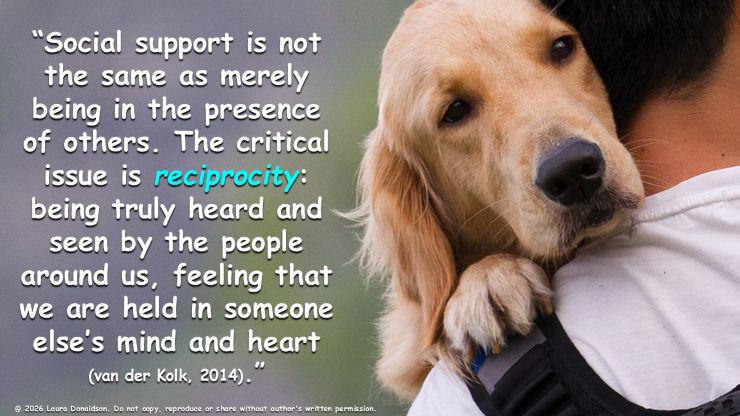
“Being able to feel safe with other people is the single most important aspect of mental health; safe connections are fundamental to meaningful and satisfying lives. Numerous studies of disaster responses around the globe have shown that social support is the most powerful protection against becoming overwhelmed by stress and trauma. Social support is not the same as merely being in the presence of others. The critical issue is reciprocity: being truly heard and seen by the people around us, feeling that we are held in someone else’s mind and heart. For our physiology to calm down, heal, and grow we need a visceral feeling of safety (Dr. Bessel van der Kolk, world renowned trauma specialist and author of The Body Keeps the Score, 2014).”
This is the third of four articles discussing the foundations for trauma healing: Deep Safety, Agency, Strong Social Support Network and yet to come, No Coercive Control.
Once upon a time there existed two children who were virtual twins since they mirrored each other in every respect, including being overwhelmed by an uncontrolled wildfire in which each child lost family members as well as their homes. Despite both suffering similar consequences (loss of family and physical residence), however, only one of the children developed PTSI (post-traumatic stress injury). In a canine version of this scenario, two pups experienced off-leash dog attacks. While neither pup sustained any physical injuries, one of them began growling and lunging at every dog she encountered soon after the attack while the other manifested almost no emotional fallout. The question, then, is why would only one subject of these two pairs be so deeply affected that they began to live in “a different universe (van der Kolk, 2014)” and the other showed enough resilience to recover from the event? To answer this, we need to explore how the reality of a STRONG SOCIAL SUPPORT NETWORK (SSSN) and how it creates a protective buffer from traumatic stress for survivors.
What is a strong social support network?
I follow Cohen and Wills’ long accepted definition of social support as providing “psychological and material resources” and promoting a capacity to cope with stress (1985). It includes family, extended family, friends, teachers and neighbors as well as pastors, rabbis, imams and other spiritual leaders. A canine SSSN would include all a dog’s interspecies partners such as other dogs, animal siblings and, of course, the dog’s humans. Over the years, research has consistently demonstrated that subjects with abundant social support display much more resilience and ability to heal from stress than those lacking it. Conversely, Sippel et al.’s meta-analysis* (2015) convincingly argues that lack of social support is a strong predictor for developing post-traumatic stress injury. As a case in point, Vietnam veterans possessing strong social support were 180% less likely to experience PTSI compared to veterans with weak support (Boscarino, 1995). Strong social support imbues subjects with a greater ability to avoid the negative fallout from severe stress, whether it is a natural disaster, an off-leash dog attack or daily events like neglect occurring over months and sometimes, even years.
For canine and human trauma survivors, the bonding of social support offers a visceral sense of Deep Safety. As van der Kolk so powerfully states, social support is not merely proximity, it is instead reciprocity: “Being truly heard and seen by the people around us, feeling that we are held in someone else’s mind and heart.” Empathizing with rather than judging our dogs; offering comfort rather than toxic labels like “stubborn” or “naughty;” digging deeper into a dog’s behavior and excavating the why’s of it—in every respect, rich social support gifts both neurobiological and psychological benefits to the dogs with whom we live and work.
How does social support help?
Did you know that saying “I love you no matter what” or “it’s not your fault” to a canine survivor prompts their body to release oxytocin, the so-called “love” hormone enabling feelings of attachment and affiliation? Or that a comforting cuddle might lessen the stress neurochemical load for struggling dogs (Ozbay et al., 2007)? Since social isolation is a crucial factor in developing post-traumatic stress, connections forged by a SSSN function as a protective buffer for trauma’s somatic and psychological consequences. Rich social networks not only grant survivors reciprocity and emotional connection but also practical and material support. The latter usually involves provisioning goods (think food) as well as social services to resolve “aftermath” issues like shelter and housing (Cohen and Wills, 1985).
Although all the above is vital, the most profound way to become part of a dog’s social support network is reciprocity, i.e., seeing and hearing them for who they really are. For anyone collaborating with dogs, living out this ethic and practice forges an unbreakable emotional, protective bond that exponentially deepens the dog-human relationship. “I see you; I hear you; I love you” are the most powerful—and healing—words we can express to any dog (or child, for that matter). Indeed, becoming a dog’s emotional support human and social support network is a foundational way to be a genuine partner and most certainly, of keeping the canine faith. Try it and I promise it will change everything in your life with dogs.
*Meta-analytic studies are the gold standard for evidence-based medicine and science. Meta-analysis provides a broad perspective by examining multiple (sometimes dozens) of studies, all of which address a common research question such as the effect of social support on post-traumatic stress.
Dr. Laura Donaldson, PhD, is a Professor Emeritus from Cornell University located Ithaca, New York, United States. She is an award-winning writer on dog behavior who has worked as a canine behavior specialist for 20 years. Laura is a Certified Dog Behavior Consultant (CDBC/IAABC) and a Karen Pryor Certified Training Partner (KPA CTP). She is also a Certified Trauma Professional. She created the very popular program, Slow Thinking is Lifesaving for Dogs® and given a number of online webinars as well as conference presentations. Laura currently lives in upstate New York (northeastern US) with her husband, working Border Collies, three cats, an African Gray parrot named Obi and a small flock of Navajo Churro sheep. https://fourpawsfourdirections.com/
References
Boscarino, J. (1995). Post-traumatic stress and associated disorders among Vietnam veterans: the significance of combat exposure and social support. Journal of Traumatic Stress, 8(2), 317-336.
Cohen, S., & Wills, T. A. (1985). Stress, social support, and the buffering hypothesis. Psychological Bulletin, 98(2), 310–357.
Eisenberger, N. (2013). An empirical review of the neural underpinnings of receiving and giving social support: implications for health. Psychosomatic Medicine, 75(6), 545-556.
Ozbay, F., Johnson, D., Dimoulas, E., Morgan, C., Charney, D. & Southwick, S. (2007). Social support and resilience to stress: from neurobiology to clinical practice. Psychiatry, 4(5), 35-40.
Sippel, L., Pietrzak, R., Charney, D., Mayes, L. & Southwick, S. (2015). How does social support enhance resilience in the trauma-exposed individual? Ecology and Society, 20(4).
van der Kolk, B. (2014). The Body Keeps the Score: Brain, Mind, and Body in the Healing of Trauma. Penguin Books.


Respect and also appreciation are sooo important. When humans focus on love, everything can change. In addition, when the good in others is honoured and appreciated, however little that might be, it flourishes and the ‘bad’ dissipates. So called ‘bad behaviour’ is simply self protection in an uncertain human world.