
SUMMER DANGER ZONE – HEAT!
By Amy Snow & Nancy Zidonis, Founders of Tallgrass Animal Acupressure Resources.
It can happen in a flash and it doesn’t even have to be that hot out. Your dog can be fine, one minute gleefully running the agility course in the mid-day sun then suddenly overheated and panting frantically. Your dog can exhibit mild overheating, or he could suffer from the beginning of a life-threatening progression toward heatstroke.
Dogs have very limited ways of ridding themselves of body heat since they do not have sweat glands the way we do. They expel heat through their respiratory system mostly, some from small sweat glands in their foot pads, and on their noses. Dogs that are most at risk for heat exhaustion are: heavy coated, or overweight, or dogs with large body mass, very young puppies, and older dogs. Another group of canines that are susceptible to heat exhaustion are dogs with short, flat noses (brachycephalic) such as Boxers, Mastiffs, Pekinese, and Bulldogs.
However, any dog can experience heatstroke in the summer when it is hot. It is up to us to be vigilant about keeping our dogs cool, hydrated, well ventilated, and avoid vigorous exercise during hot and humid days.
Indicators of Heatstroke
Heatstroke occurs when the dog’s body can no longer control his own body heat. Indicators of heatstroke tend to follow a progression from mild to severe:
- Loud, frantic panting
- Temperature over 103F
- Elevated heart rate
- Agitation
- Excessive, frothy salivation
- Dark purple gums
- Vomiting
- Diarrhea
- Muscle cramping
- Seizure-like tremors
- Weakness
- Dazed and disoriented
- Loss of balance
- Collapse
- Loss of Consciousness
- Death
Unfortunately, the outcome of severe heatstroke is usually not good. If a dog does survive, he will most likely sustain permanent organ and, possibly, brain damage. This is why it is so important to prevent heat exhaustion. But it can happen inadvertently and when it does here’s what you need to do.
The Cooling Process & Acupressure
If a dog’s body temperature edges near or above 103F, he has entered the danger zone. (Normal temperature for a dog is 100 to 102.5F.) Stop all activity, offer fresh water, wet the dog down with cool water and allow him rest in a breezy, shaded area if you are outside or when inside in front of a fan or air conditioning would be best. Evaporative cooling is a good way to keep your dog cool enough to bring down his body temperature.
Once you have begun the cool-down process there are specific acupressure points that you can use to enhance the dog’s ability to expel body heat. While you are either applying finger pressure or scratching the suggested acupressure points do not confine the dog and continues to provide ventilation. During the cooling process, head to your holistic veterinarian to make sure no internal damage has occurred.
WARNING: Applying ice or extremely cold water while cooling the dog is not recommended. The extreme cold can cause the dog’s skin to contract and not allow the heat to escape. Covering the dog with a wet towel could capture body heat as well.
If the dog’s temperature goes over 105F he is in grave danger and immediate veterinary care is necessary. Quickly follow the cooling process: wet the dog completely and spray cool water to his neck and groin areas where the blood vessels are superficial. While in route to the emergency veterinary clinic, you can apply finger pressure or scratch the acupressure points that increase your dog’s capacity to release heat.
Acupressure for Releasing Body Heat
Acupressure is based on Traditional Chinese Medicine, which has been used with animals for centuries. It is noninvasive, safe, always available, and gentle yet powerful. Dogs enjoy their special person’s touch. Plus, taking the time to focus on healing creates a special bond between you and your dog.
The acupressure points, also called “acupoints,” have been specifically selected to help the dog release internal body heat, support respiratory function, and assist in calming the animal.
Governing Vessel 14 (GV 14) is commonly used to clear heat from the entire body. This acupoint is located on the midline of the dog at the base of the neck in front of the shoulder blades (scapula).
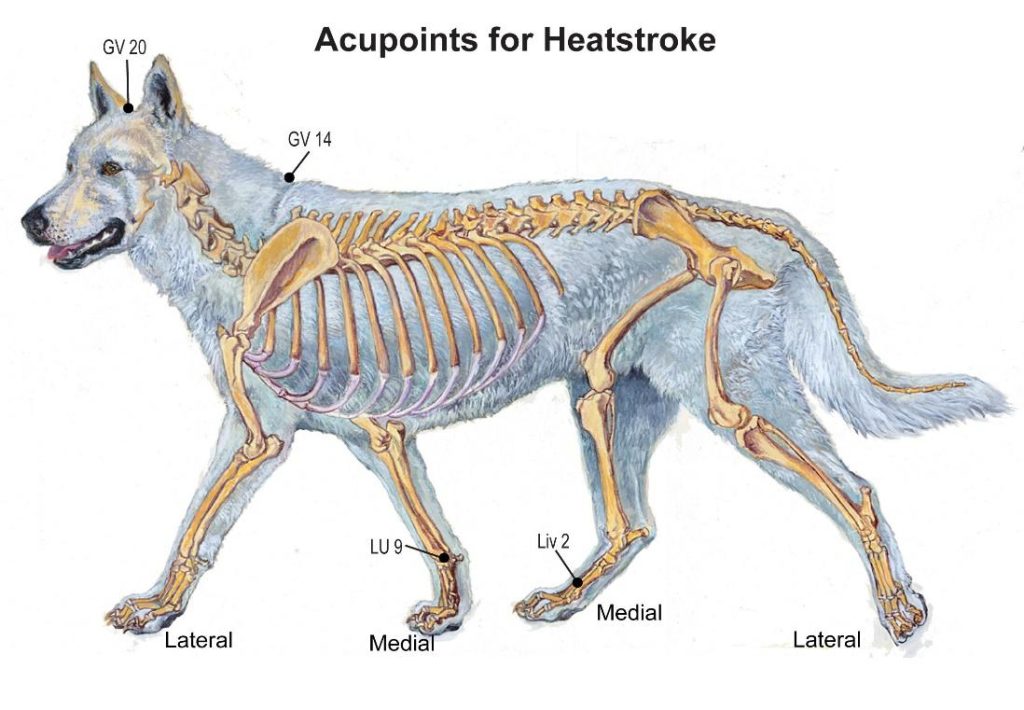
Governing Vessel 20 (GV20) has the attribute of clearing heat, thus helping the dog release heat and it also clears and calms the dog’s mind. This point will help reduce the anxiety the dog is experiencing while struggling to cool down. GV 20 is located at the very top of the dog’s head, on the midline between his ears.
Liver 2 (Liv 2) is a known acupoint for cooling blood heat and calming the heart. Liver 2 is on the hind paws right on top of the webbing between the first and second digits (seen from the medial, or inside).
Lung 9 (Lu 9) is a key acupressure point that supports lung function, clears heat, and promotes the vital energy of the arteries. The attributes of Lung 9 can greatly benefit a dog suffering from any level of heatstroke. This point is located on the forelimbs, just above the wrist on the inside, or medial aspect, toward the front of the leg.
To be most effective in cooling and helping the dog breathe, lightly scratch each of these acupoints using your index and middle fingers. Have the hand that is not scratching the point resting gently and comfortably on the dog’s body. If at any time your dog moves away or seems in more distress, please discontinue further acupressure. Contact your veterinarian and follow his or her recommendations.
Heatstroke is serious and prevention makes the most sense. During the warmer seasons watch for the mildest signs that your dog is overheating and remember to wet him down, keep him in the shade and well ventilated at the first indication he is getting hot. The acupressure points given will help bring his heat level down more quickly and support your dog’s health.
Acupressure offers you and your dog thousands of years of health and wellbeing. It’s safe, always available, and gentle yet powerful. Tallgrass has all the resources you need to learn and apply canine acupressure-massage. There’s an Online Training program especially for dog guardians, plus, ACU-DOG: A Guide to Canine Acupressure book, Meridian Charts, Apps, and a website with articles and blogs to get started here. Email: tallgrass@animalacupressusre.com.


