
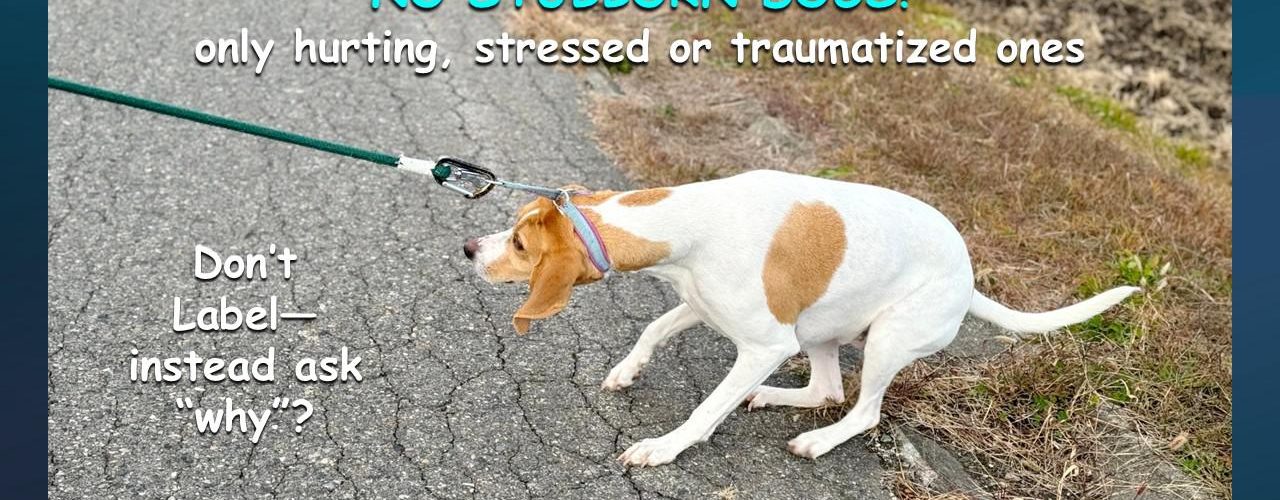
No Stubborn Dogs! Only Hurting, Stressed or Traumatized Ones
By Dr. Laura Donaldson, PhD, CDBC, KPA CTP.
“Resistance is information, and your job is to become curious enough to understand the message.” – Dr. Arielle Schwartz
Has your dog ever given you a hard STOP! on walks or refused to leave the house? Most instances of canine resistance are interpreted as defiance, naughty behavior or just plain stubbornness. As a troubled caregiver revealed in a recent dog advice column, “our two-year-old Golden Retriever only walks short distances. He then flops down on the ground and rolls over on his side. To get him moving, I simultaneously pull on his collar and harness. Eventually he walks, but a short distance later, he lies down again. I feel he is trying to be the boss . . .” Although there are many reasons why a dog might “flop down” on a leashed walk, immediately assuming it implies unruly or dominant behavior misses the point. Instead, clinical psychologist and trauma specialist Dr. Arielle Schwartz suggests we should consider this resistant behavior as information and ask WHY it happens: investigate rather than using toxic labels.
A frequently overlooked reason for “flopping” is the ongoing effect of traumatic stress—physical pain is another one. Indeed, both human and canine subjects use AVOIDANCE, or shunning people, places and events as a strategy for coping with trauma’s ongoing effects. Certified Applied Animal Behaviorist Patricia McConnell* notes that “some dogs will go to great lengths to avoid certain situations or environmental triggers. Others will present as “emotionally numb,’ staring blank-faced out of a crate for days at a time. We can’t, however, know if dogs are suffering from guilt or depression, but we can observe dogs who behave like depressed people behave.” Frequently, for both humans and dogs, the onset of full-blown traumatic stress can be delayed by days, months and sometimes even years, but that seldom lessens its devastating impact or its ability to activate resistance as a coping mechanism.
If a dog stops on a walk or refuses to leave the house, forcing or pressuring the dog, even if using positive reinforcement and done with the best of intentions, risks re-traumatizing them or intensifying their physical pain. Stopping is a dog’s way of saying that the current situation is untenable and humans need to take this communication very seriously. So, the next time your dog plants their feet (or backside) on a walk, remember that resistance is information and your job is to understand the message your canine partner is sending through their stopping or refusal behavior. This is one of the best ways to be a loving partner to those sentient, intelligent and emotionally rich beings known as Canis Familiaris. Keep the Canine Faith!!!!
Dr. Laura Donaldson, PhD, is a Professor Emeritus from Cornell University located Ithaca, New York, United States. She is an award-winning writer on dog behavior who has worked as a canine behavior specialist for 20 years. Laura is a Certified Dog Behavior Consultant (CDBC/IAABC) and a Karen Pryor Certified Training Partner (KPA CTP). She is also a Certified Trauma Professional. She created the very popular program, Slow Thinking is Lifesaving for Dogs® and given a number of online webinars as well as conference presentations. Laura currently lives in upstate New York (northeastern US) with her husband, working Border Collies, three cats, an African Gray parrot named Obi and a small flock of Navajo Churro sheep. https://fourpawsfourdirections.com
References:
McConnell, Patricia (2014). “People, dogs and psychological trauma” (keynote address). Association of Pet Dog Trainers 20th Annual Conference. Hartford, CT.
Schwartz, A. (2020). The complex ptsd workbook: a mind-body approach to regaining emotional control and becoming whole. Sheldon Press.


You know sometimes they are just being a dog and that is not a helpful behaviour in the situation. Our dog senses a ‘monster; and wants to sit and wait for it to arrive so that he can have a pop at it and make it go away. It WAS away! And if he had moved on we would have avoided it altogether or been able to process it from a safe distance!
I trust his herd guardian type instincts completely. He needs to trust my knowledge of the world too.