
Barking at the Mailman: Why Your Dog (and You!) Fall for the “Superstition Trap”
By iKE ALLEN, Happy Healthy Dog Co-Founder.
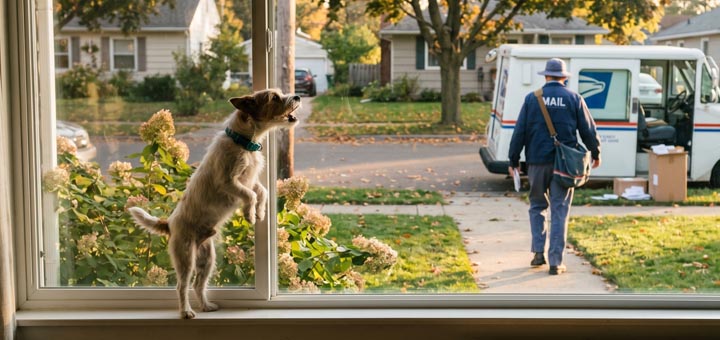
We’ve all been there. You’re peacefully sinking deeper into the couch, and suddenly, your dog launches off their bed, sprinting to the window like their life depends on it. They’re barking their head off at the mailman, a squirrel, or maybe just the wind.
Once the “intruder” leaves, your dog trots back to you, tail wagging, looking like they just defended the fortress from a battalion of enemies.
To your dog, the logic is simple: I barked, and the threat left. Therefore, my barking saved us. It’s hilarious when they do it, but here’s the kicker: We do this, too. It’s called a false correlation, and it’s a major cognitive trap that keeps both you and your dog stuck in unnecessary stress.
The Mailman Syndrome (Or, The “Superstition Trap”)
In behavioral science, what your dog is doing is a classic case of Confirmation Bias. They aren’t actually “saving” the house; the mailman was leaving anyway. But because the mailman left after the dog barked, the dog’s brain locks that sequence in as a “win.”
They don’t know the mailman has a schedule; they only know their routine:
- Trigger: Mailman appears.
- Action: I bark (the “superstition”).
- Result: Mailman leaves (the “reward”).
The dog’s brain never considers that the mailman would have left without the barking. They’ve fallen into a superstition trap, and they’re going to repeat it every single day.
[ReThink] Your Own “Barking”
How often do you do this in your own life?
We have these “mental mailmen” everywhere. Maybe you worry about a project at work all weekend, Monday comes, and it goes fine. You might think, “See? My worrying kept me prepared.” Or perhaps you obsess over a health symptom, it goes away, and you think, “If I hadn’t checked WebMD, I wouldn’t have known how to handle it.”
We credit our anxiety for our safety. We bark at our problems, and when they eventually resolve on their own, we convince ourselves that our “barking”—our stress, our obsessing, our frantic energy—was the reason for the success.
It’s a cycle that keeps our nervous system on high alert for no reason. If you’re tired of the “Sunday Scaries” or that constant feeling of needing to be “on guard,” it might be time to [ReThink] your own internal patterns.
How to Help Your Dog (And Yourself) Break the Cycle
The goal for both you and your dog is to stop “barking” at threats that were never going to hurt you in the first place. Here’s how to do it:
For Your Dog:
- The “Ignore” Game: Don’t scold them (which adds more noise/energy to the situation). Instead, teach them a “place” command or a “quiet” command that redirects their focus before they start the show.
- Desensitization: If they bark at the mailman, start giving them high-value treats before they start barking when the truck pulls up. You’re changing the association from “This is a threat!” to “Oh, a delivery is coming? That means I get chicken!”
For You (The [ReThink] Exercise):
Next time you feel that urge to “bark”—to stress, to obsess, or to over-prepare for something that’s likely going to be fine—pause and run through this check:
- Identify the Trigger: What is the “mailman” in my life right now? (e.g., An upcoming meeting, a social event, a financial worry).
- Check the Logic: Is my stress actually causing the outcome, or is it just happening simultaneously?
- The Pivot: What could I do instead of “barking”? (e.g., Take a walk, do three minutes of deep breathing, or just put the phone down).
The Bottom Line
Your dog is a genius in many ways, but they don’t always understand the full picture. Neither do we.
When you learn to [ReThink] these superstitious loops, you stop living in a state of constant, defensive reactivity. You realize that you don’t have to bark at the world to keep it safe. Sometimes, the best way to handle a “mailman” is just to let them pass by while you keep your cool.
Being willing to ReThink everything takes time, patience, and self-love. But I promise it’s worth it in the long (dog) run. Honestly? Once you get the hang of it, you’ll be so zen, even the cat might be impressed.”


