
To Heal From Trauma, Dogs Need Freedom From Coercion
By Dr. Laura Donaldson, CDBC, KPA CTP.
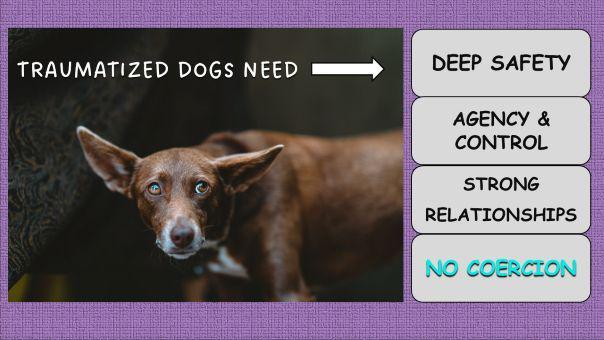
This is the final offering for my Happy Healthy Dog series on the four foundations enabling healing from trauma.
When I was in high school, I took a creative writing class whose teacher insisted on one absolute rule of “good writing”: never, ever begin an essay with a dictionary definition. I have followed this advice faithfully—until now, that is. I decided to break with tradition because coercion is just that sort of expansive, complicated term. Dictionary.com defines it as “the use of force or intimidation to obtain compliance.” According to the Oxford Dictionary, this concept involves “the practice of persuading someone to do something by using force or threats.” Clearly, then, coercion implies obtaining a subject’s consent not only through physical force but also psychological weapons like intimidation, threats and shaming. As a concept,it contains layers of the physical, the emotional, the legal, the institutional, and the economic (Gemini AI, 2026). What connects these coersive layers is the process of violating a subject’s capacity to give consent freely and independently.
If coercion is so complex, why then adopt it as one of the four foundations promoting healing from trauma? Why not use something more straightforwardly transparent like “no punishment?” While the concept of “no coercion” does prohibit pain inflicting technologies like shock or prong collars (or any aversive method based on fear and force), it also encompasses many additional ways to violate a subject’s consent. Take the issue of pressure, for example.
We know that new learning necessitates some stress and pressure to become permanently encoded in the brain. However, too much pressure blocks new learning and often reactivates traumatic overwhelm. This “unreasonable” pressure pushes canine and human subjects to engage in actions they have an innate right to refuse and can trigger traumatic regressions. It is important to note that what constitutes unreasonable pressure is different for every dog. Indeed, unreasonable pressure ranges across a continuum from tiny, virtually invisible amounts to huge doses, or what I call “macro-pressure.” Here are several examples illustrating how unreasonable pressure works in real life:
- Human Example: Someone coerces you into giving them money by threatening to harm you or your loved ones (Barrientos, 2024).
- Canine Equivalent: A dog who was recently attacked by a neighbor’s off-leash dog subsequently refuses to leave the house. Exasperated, their human puts a prong collar on the dog and drags them out the front door. To avoid the pain of the prong collar, the dog disregards their anxiety about a now seemingly dangerous outside environment and reluctantly accompanies the human on a walk.
- Human Example: A domestic partner pressures you to agree by means of emotional manipulation—“if you don’t do what I say, I’ll break up with you (Barrientos, 2024).”
- Canine Equivalent: A human decides to “socialize” her highly food-motivated dog to strangers by directing an unknown person to deliver a high value treat to the dog by hand. The dog, who becomes very stressed and hypervigilant around strangers, takes the treat but then realizes they are in dangerous space (i.e., close proximity to the unknown human). When the dog barks and growls at the stranger, they are scolded and labeled a “bad dog!”
As Barrientos (2024) notes, “in each of these examples, the core element of coercion is that the individual’s decision-making process is heavily influenced or controlled by external pressures, undermining the individual’s ability to make an independent, unforced choice.” It does not matter if the individual in question is canine or human, coercion—whether it involves unreasonable pressure or a pain-inflicting collar—actively undermines the subject’s agency as well as their capcity for voluntary cooperation. as I have argued in the second offering of this series on the four foundations of trauma healing, relearning agency is critical for any healing from trauma.
Deep Safety, Agency, Strong Social Support Network and now, No Coercion: these are the foundations supporting healing from trauma. Making them a way of life for your dog will offer the best chance of helping them recover from the devastating overwhelm known as traumatic stress. Peace, love and free will.
Dr. Laura Donaldson, PhD, is a Professor Emeritus from Cornell University located Ithaca, New York, United States. She is an award-winning writer on dog behavior who has worked as a canine behavior specialist for 20 years. Laura is a Certified Dog Behavior Consultant (CDBC/IAABC) and a Karen Pryor Certified Training Partner (KPA CTP). She is also a Certified Trauma Professional. She created the very popular program, Slow Thinking is Lifesaving for Dogs® and given a number of online webinars as well as conference presentations. Laura currently lives in upstate New York (northeastern US) with her husband, working Border Collies, three cats, an African Gray parrot named Obi and a small flock of Navajo Churro sheep. https://fourpawsfourdirections.com/
REFERENCES
Anderson, S. (2023). Coercion. In E. Zalta & U. Nodelman (Eds.), The Stanford Encyclopedia of Philosophy (Spring 2023 ed.). Metaphysics Research Lab, Stanford University. https://plato.stanford.edu/archives/spr2023/entries/coercion
Barrientos, E. (2024). Coercion and threats as a tactic of control (Blog). Northwestern Illinois YWCA. https://www.ywcanwil.org/coercion-and-threats-as-a-tactic-of-control. Gemini AI. (2026). Response to Inquiry on Coercion. Google. https://bit.ly/4qNrqcN


Very informative. Thank you.
I love it! We need to stop and listen. Trying to understand. No-one should ever be coerced unless they pose a direct and indisputable danger. Even then, things can often be managed in a more fruitful way.