
For Dogs To Heal From Trauma They Need To Relearn Agency
By Dr. Laura Donaldson, PhD, CDBC, KPA CTP.
For dogs to heal from trauma (or any Big Feelings), they need to rediscover the following experiential, somatic and psychological truths:
- Deep Safety
- Agency
- A Strong Social Support Network
- No Coercion
In my last offering on trauma in dogs, I explored the foundation of Deep Safety and argued it provided the bedrock for any healing from trauma: Deep Safety first, foremost, always. This month, I explore the notion of “agency” and over the next several months, my offerings will focus on the meaning of a “strong social network” as well as “no coercion.” While multiple definitions of agency exist, I prefer the simple, yet powerful characterization penned by the United Nations Girls’ Education Initiative: “Agency is a person’s capacity to make choices and act in accordance with their values and desires. Agency is shaped by one’s social location, power, and material resources, and structural constraints. It can be individual or collective.”
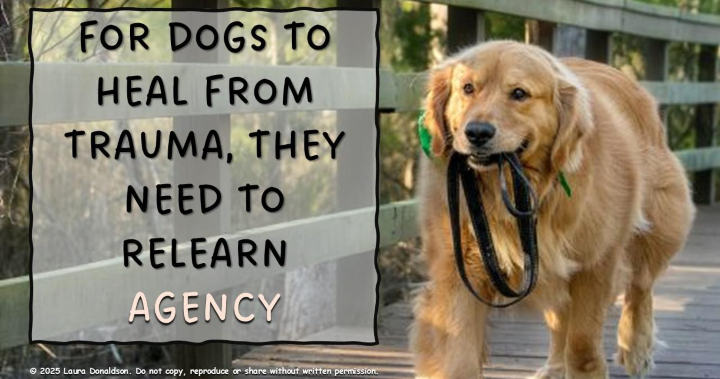
The first takeaway for understanding agency is: “it’s complicated!” Indeed, each act of choosing and acting in accordance traverses multiple external pressures, fractures and forces—cultural, social, economic, racial, biological—that are impossible for individual subjects to control. At best, for example, dogs inhabit contexts enabling certain forms of choosing and acting in accordance but disallowing others. As psychologist Gabor Maté (2022) has observed, agency does not mean “some sort of false omnipotence or ultimate dominion over all happenings and circumstances. Life is so much bigger than us, and we do not forward our own healing by pretending to be in control where we’re not.” Of course, dogs are hardly ever “in control” of their individual situations. Like human children, they do not ask to be born into a particular context and they usually lack control over basic processes like feeding, exercising and sleeping. This is why I found the graphic of a Golden Retriever happily trotting across a bridge while holding a leash in her mouth so insightful: this dog likely did not dictate when her walk occurred, what technology she wore or even what household she inhabited. However, within these limits, she does carry her own leash, i.e., is able to make decisions about how and when she navigates her environment.
For trauma survivors, the picture is even more complex because traumatic stress often disrupts any sense of being able to control one’s life. As renowned trauma specialist Dr. Bessel van der Kolk (2014) once noted, a devastating effect of trauma is its compromising of the brain area that communicates “the physical, embodied feeling of being alive.” Because of this, the reality for trauma survivors is too often emotional and somatic overwhelm rather than acting in accordance. While this might sound bleak, we also know that “the exercise of agency is powerfully healing (Maté & Maté, 2022).” This is why traumatized dogs need their human caregivers not only to understand how trauma disrupts their “embodied feeling of being alive” but also how even small experiences of agency help survivors heal.
In an ironic twist, sometimes those actions humans love to hate in their dogs are actually performances of agency. A case in point is dogs refusing to leave the house or stopping out on walks. What if this resistance did not signify nuisance or stubborn behaviors but instead functioned as an innate “means of self-protection, aiming to minimize the risk and vulnerability to risk (Adrien et al., 2022)?” I will say more about helping our dogs relearn agency in next month’s offering on the importance of a strong social support network. For now, though, it is critical to know that relearning agency necessitates a broader, more transformative agenda than just giving dogs “choice” (a highly popular option in dog training at the moment). Relearning agency involves dogs realizing they are authentically seen and heard as well as their ability to reshape their world in Deeply Safe ways. This is the path of healing for traumatized dogs (and all trauma survivors, for that matter). To be continued next month …
Dr. Laura Donaldson, PhD, is a Professor Emeritus from Cornell University located Ithaca, New York, United States. She is an award-winning writer on dog behavior who has worked as a canine behavior specialist for 20 years. Laura is a Certified Dog Behavior Consultant (CDBC/IAABC) and a Karen Pryor Certified Training Partner (KPA CTP). She is also a Certified Trauma Professional. She created the very popular program, Slow Thinking is Lifesaving for Dogs® and given a number of online webinars as well as conference presentations. Laura currently lives in upstate New York (northeastern US) with her husband, working Border Collies, three cats, an African Gray parrot named Obi and a small flock of Navajo Churro sheep. https://fourpawsfourdirections.com/
References
Adrien, V., Bosc, N., Peccia Galletto, C., Diot, T., Claverie, D., Reggente, N., Trousselard, M., Bui, E., Baubet, T. & Schoeller, F. (2024). Enhancing agency in posttraumatic stress disorder therapies through sensorimotor technologies. Journal of Medical Internet Research, 26.
Anonymous. (n/a). Your gender transformative education glossary: what is agency? https://www.ungei.org/gender-transformative-education-glossary/towards-transformations/agency
Maté, G., & Maté, D. (2022). The myth of normal: trauma, illness, and healing in a toxic culture. Avery.
van der Kolk, Bessel. (2014). The body keeps the score: brain, mind, and body in the healing of trauma. Penguin Books.


