
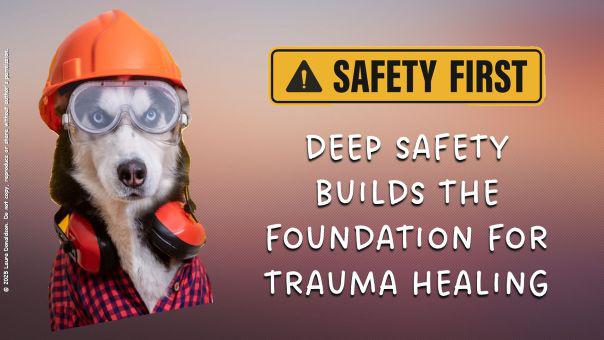
Deep Safety Builds The Foundation For Trauma Healing
(Graphic & text ©2025, Laura Donaldson)
By Dr. Laura Donaldson, PhD, CDBC, KPA CTP.
Several years ago, I introduced the concept of DEEP SAFETY to help human caregivers recognize and address the devastating struggles of traumatized dogs. My understanding of Deep Safety was shaped by my work in human trauma studies and most especially, by research on traumatized children (Tucci et al., 2018). At that time, I had not heard anyone use the term, “Deep Safety,” in relation to dogs. This is why I am thrilled to note that currently, many more people have joined me in referring to both this concept and its best practices as critical to their lives with animals. I would like to think I played a role in promoting this visibility because Deep Safety provides the bedrock foundation on which I base everything I do in my professional as well as personal life.
Deep Safety implies much more than external activities like fencing in a yard or doing muzzle training with dogs. While a locked door, fenced-in yard and dogs wearing muzzles are important (and I constantly recommend such options to clients), Deep Safety is instead embodied and visceral, not only psychological but also physiological: “It is felt in our hearts. It is held in our lungs as we breathe. It is also a connected experience. It lies in the tone of voices of those who love us. It is found in their gazes and their hand gestures (Tucci et.al., 2018).” Without this emotional, somatic (body-based) sense of a non-threatening world as well as trust in relationships, healing from trauma becomes exceedingly difficult. There are multiple pathways for practicing and learning the ways of Deep Safety. I highlighted a particularly crucial one in my May 2025 Happy, Healthy Dog article, “A PROSODY OF SAFETY: TEACHING THE BODY IT IS SAFE IN THE PRESENT”. Prosody includes a subject’s vocal rhythms, frequency and tone—it is the music of how one talks.
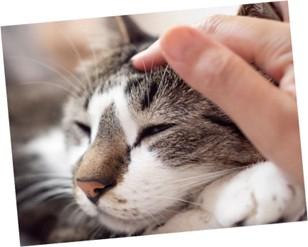
Our prosody communicates safety or danger to our own neurobiology as well as that of others. In this article, I even offered access to a recording of how a Prosody of Safety might sound. Other pathways enabling our dog’s journey to Deep Safety are evidenced-based Emotional Freedom Techniques like Touch and Breathe shown in the accompanying photo. In this picture, the human hand on the top center of the cat’s head gently holds an acupressure point known as Governing Vessel 20.* The meridian system known as Governing Vessel traverses the entire body, is unattached to any single bodily organ and exerts a powerful, calming effect (whether the subject is human, canine or feline). Gently holding GV 20 or stroking it from front to back soothes an animal’s anxieties and lowers their stress levels. Other practices like grounding, breathwork and trauma-sensitive movement also help companion animals experience the relational and somatic harmony of Deep Safety.
However, it is critical to remember that although humans can facilitate learning about the world as a safe place, healing only emerges from within the individual canine. It cannot be externally coerced or forced. Pressuring dogs to “feel safe” is not just counterproductive but far too often, actively harmful. This is why time and space plus patience and compassion are the greatest gifts we can give the dogs who we love and with whom we live and work. They deserve nothing less.
*AcupointGV20 is located on top of the head, midway between the ears where the skull’s bony ridges converge. This applies to GV20’s position for both humans and dogs.
Dr. Laura Donaldson, PhD, is a Professor Emeritus from Cornell University located Ithaca, New York, United States. She is an award-winning writer on dog behavior who has worked as a canine behavior specialist for 20 years. Laura is a Certified Dog Behavior Consultant (CDBC/IAABC) and a Karen Pryor Certified Training Partner (KPA CTP). She is also a Certified Trauma Professional. She created the very popular program, Slow Thinking is Lifesaving for Dogs® and given a number of online webinars as well as conference presentations. Laura currently lives in upstate New York (northeastern US) with her husband, working Border Collies, three cats, an African Gray parrot named Obi and a small flock of Navajo Churro sheep. https://fourpawsfourdirections.com/
References
Mahler, K. (2025). Facebook post: felt safety is earned, not demanded. Interoception: the eighth sensory system. https://www.facebook.com/kellymahler.
Tucci, J., Weller, A., & Mitchell, J. (2018). Realizing “deep” safety for children who have experienced abuse: application of polyvagal theory in therapeutic work with traumatized children and young people. In S. Porges & D. Dana (Eds.), Clinical applications of the polyvagal theory: the emergence of polyvagal-informed therapies. W.W. Norton & Co.


