
WHEN WORRY BECOMES CANINE COMPULSIVE DISOREDER
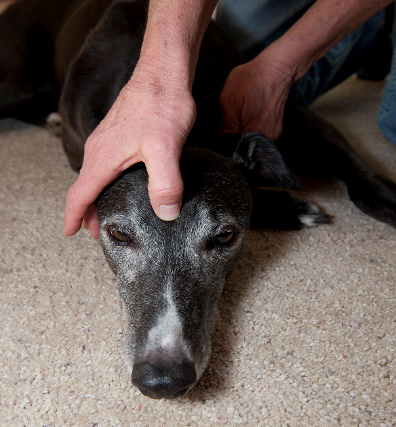
By Amy Snow & Nancy Zidonis, Tallgrass Animal Acupressure Resources.
Is your dog worried? A dog may seem tentative and apprehensive when presented with a potential threat. Many dogs express worry by quirky or repetitive behaviors, which can develop into anxiety disorders when worry is prolonged.
Healthy Worry
There is a healthy level of worry. Worry is a form of self-protection. It shows that the dog is thinking and selecting an appropriate response to a threatening situation. The dog is aware of danger and is considering how to avoid injury. This is basic self-preservation, which is a healthy response to a threat. A dog in danger usually indicates his level of stress by demonstrating behaviors such as flattening his ears, his eyes appear wary, or he might intentionally look away. Body language could indicate avoidance by staying stark still or slowly arcing around the dangerous prospect.
Healthy responses to a worrisome situation are usually short-lived. A dog is doing his best to cope with a momentary concern like an aggressive dog or a dangerous event. However, there is another more extreme level of worry when a dog is compulsively repeating a behavior that has nothing to do with an immediate threat or trigger. This is excessive over-thinking; this level of anxiety is beyond current self-protection and survival. Ironically, this extreme level often results in the dog causing himself harm. This is called Canine Compulsive Disorder (CCD).
Canine Compulsive Disorder
Behaviors associated with CCD serve to relieve a dog’s anxiety. Common CCD behaviors include licking their foreleg incessantly, non-stop tail chasing, spinning in circles endlessly, monotonous barking, air-snapping, nail or foot chewing, sucking on the flank, ingesting just about anything, over-drinking water and other repetitive behaviors that appear to have no immediate causation.
Genesis of CCD
Once a wholistic veterinarian has examined the dog and has determined that there is no medical condition underlying destructive behavior, the next step is to review the dog’s environment and lifestyle. There are specific breeds that are genetically predisposed to particular types of CCD such as herding dogs often chase or nip while retrievers tend to be overly mouthy.
When and how did this behavior begin? Dogs that are kenneled or kept indoors for many hours can become frustrated from lack of exercise and sensory stimulation have a higher possibility of developing CCD. Confinement is probably the greatest contributor to dogs suffering from CCD. Dogs are pack animals not loners; being left alone for long periods of time can cause stress. Household conflict can be stressful and lead to CCD.
Knowing the genesis of the behavior helps to determine how to approach resolving CCD. Realizing that the dog is inadvertently being rewarded for unwanted repetitive behavior, such as hyper-jumping, when all the dog really needs is attention. Providing the dog with positive attention often helps resolve problem behaviors. Punishment rarely extinguishes behaviors associated with CCD, in fact, punishing the animal usually causes further stress.
Combined Approach
There are many non-drug approaches to help a dog overcome CCD. Acupressure is known to reduce the dog’s stress level while simultaneously establishing new energetic patterns that can support behavior change. Consulting a professional trainer to help design a behavior modification program can be helpful. There are homeopathies, herbal remedies, essential oils, and flower essences available to support the dogs contending with long-term stressors.
The best approach to working with CCD is usually a combined approach. Acupressure offers the benefit of enhancing the effectiveness of behavior modification, herbal and other remedies. Acupressure is based on the principals of Traditional Chinese Medicine (TCM). From the TCM perspective, the extremely deep level of anxiety that underlies CCD indicates both a disturbance of the animal’s spirit and, most likely, his basic needs are not met.
When a dog is highly frustrated or conflicted for an extended time, his anxiety builds and his concern for his very survival increases. To relieve this anxiety, he may repetitively lick his foreleg until it is raw or chew his own paw, two very common expressions of anxiety. If an animal hurts himself, we know that his spirit has been seriously injured, and his sense of security is threatened.
Acupressure Session
There are specific acupressure points, pools of energy, on the dog’s body when stimulated can relieve the anxiety the dog is experiencing and support his self-confidence and sense of security.
The acupoints selected for this session are specifically known to calm the spirit while providing a sense of “grounding.”
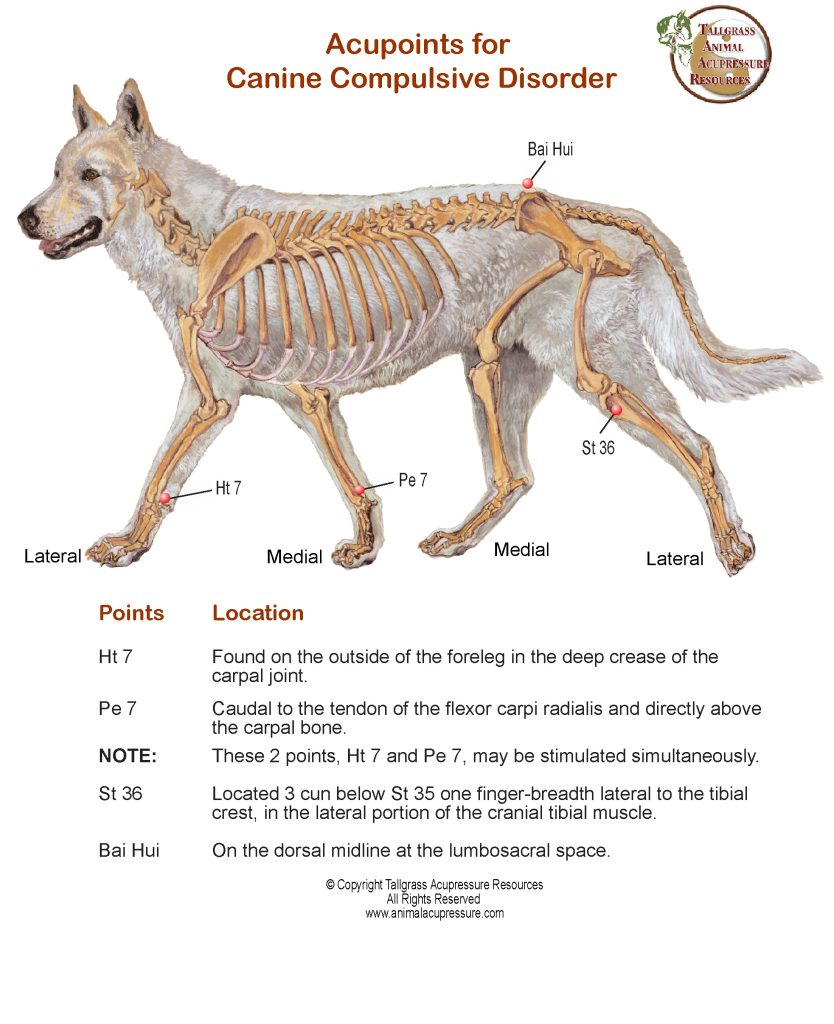
ACUPRESSURE FOR CANINE COMPULSIVE DISORDERS
Start the session by slowly stroking down from the dog’s head toward his tail just off his spine, or midline of his back. Repeat the stroking three times on both sides of the dog. This indicates to the dog that you are doing something different than when you are usually petting him. Follow the chart, place the soft tip of your thumb or pointer finger at a 45% angle on each point sequentially while staying on each point for at least a slow count to 20. Repeat the points on both sides of your dog. To finish the session, stroke your dog with loving intent from head to tail three times on each side of hie body the same way you started the session.
While stimulating each point, think about how much you love your dog and want to meet his needs so that he will feel secure. If you repeat this acupressure session every three or four days for four to six weeks, the dog will believe you and you will build a mutual, comforting bond.
Acupressure offers you and your dog thousands of years of health and wellbeing. It’s safe, always available, and gentle yet powerful. Tallgrass has all the resources you need to learn and apply canine acupressure-massage. There’s an Online Training program especially for dog guardians, plus, ACU-DOG: A Guide to Canine Acupressure book, Meridian Charts, Apps, and a website with articles and blogs to get started: www.animalacupressure.com. Email: tallgrass@animalacupressusre.com.


