
Trauma Sensitive Movement Offers Powerful Healing for Dogs
By Dr. Laura Donaldson, PhD, CDBC, KPA CTP.
According to Dr. Bessel van der Kolk (2014), renowned trauma specialist and author of The Body Keeps the Score: “Trauma is much more than a story about the past that explains why people are frightened, angry or out of control. Trauma is re-experienced in the present, not as a story, but as profoundly disturbing physical sensations and emotions that may not be consciously associated with memories of past trauma. Terror, rage and helplessness are manifested as bodily reactions, like a pounding heart, nausea, gut-wrenching sensations and characteristic body movements that signify collapse, rigidity or rage . . . The challenge in recovering from trauma is to learn to tolerate feeling what you feel and knowing what you know without becoming overwhelmed.” Talk therapy for humans and cue/command training for dogs are frequently ineffective in addressing gut wrench, terror and overwhelm as daily patterns of living. This is because top-down approaches never reach deeply enough into the “survival brain” to heal the powerful emotional and somatic learnings that van der Kolk describes.
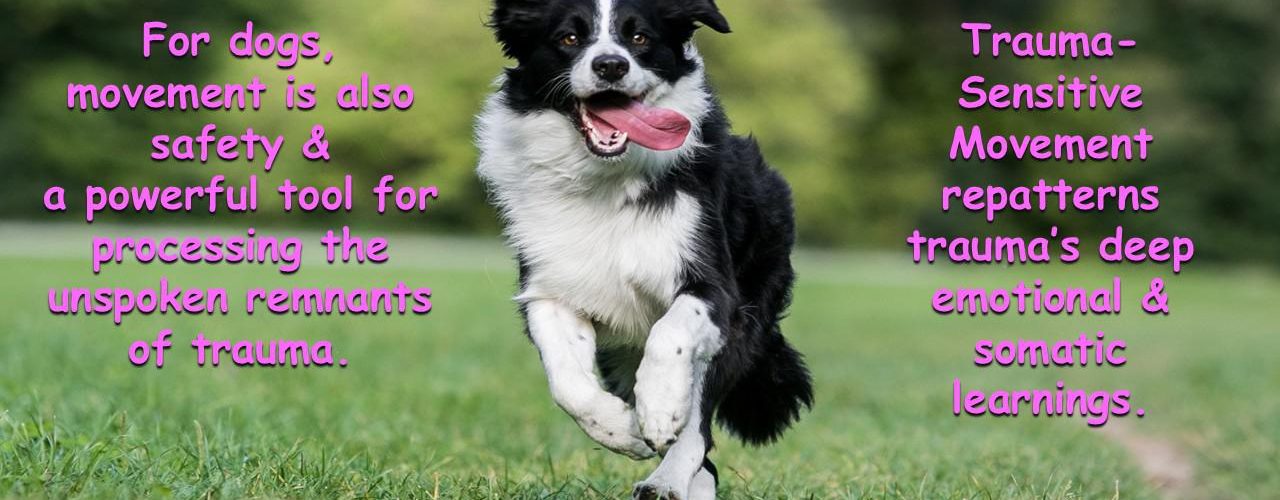
You might be asking why this is important for traumatized dogs—isn’t this description only relevant to human trauma survivors? Absolutely not! We now know that dogs and humans possess closely similar social and emotional brains (Siracusa, 2018) and this includes the way their brains and bodies process traumatic stress. For both dogs and humans, “somatic,” bottom-up therapies offer healing where more traditional top-down approaches have failed. A case in point is movement—or more particularly, Trauma Sensitive Movement (TSM). Movement is different from physical exercise. After all, bodies move even when they are still. Breathing, blood circulation and heart beats are autonomic movements that keep us alive whether we are exercising or moving our limbs. Bodies in pain and bodies that have lost some or all their physical abilities “still have the option to feel deep intrinsic movements. Movement is about range and depth of connection, not limited to ability (Mischke-Reeds, 2025).” TSM focuses on safety, agency and enabling survivors to repattern the unprocessed, unspoken remnants of traumatic experience living in the body and causing so much ongoing devastation.
For example, an infant who falls or is not physically supported can develop deeply embedded feelings that the world is not a safe place. Puppies picked up and sometimes, dropped by children (or adults) who do not know how to support a youngster’s head and body can develop similar unsafe Big Feelings exceedingly early in their lives. For these pups, a TSM called grounding works to repattern these emotional and physical learnings. Grounding is a dissipating movement evacuating hyperarousal from the body and reconnecting the pup with experiences of deep safety. This simultaneous outward and inward flow also helps the pup regulate any traumatic activation. I usually begin the process of grounding slowly by repurposing a Two Paws Up behavior of the dog placing both front paws on a square foam block. You might also begin noticing how your dog creatively self-grounds by placing their paws on other objects or seeking proximity to parts of their human’s body (the human lap is a favorite site for this). For example, jumping on people often represents a dog attempt to self-ground rather than automatically qualifying as a “nuisance” behavior. Grounding involves discharging—the flow of hyperarousal out of the body and into the “ground”—as well as recirculating feelings of calmness and connection back into the body. In addition, grounding develops a proprioceptive awareness of the legs and feet that builds tolerance for strong sensations (Schwartz, 2018). This is an absolute necessity for dogs who have been traumatized or worry about their environment.
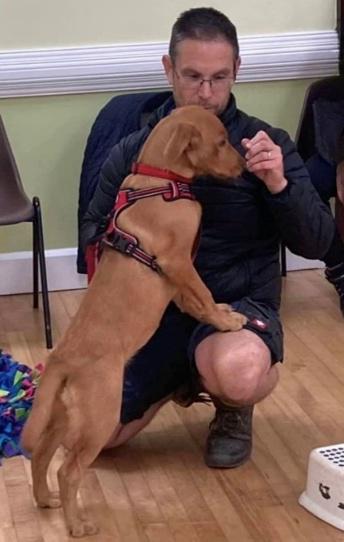
(Puppy grounding on her human’s thigh)
Who knew that movement could be so healing? And grounding is only one example. If you take my Trauma Sensitive Movement for Dogs webinar (see the information below), you will gain many more practical strategies and innovative ideas about incorporating TSM into your daily life with dogs. Here are some guidelines for making TSM an ethical AND successful component of all your canine partnerships:
- Honor the dog’s boundaries—never push or impose an agenda on them. The dog’s agency and consent are critical here.
- Respect your dog when they say “No” and track for any unspoken refusals they might be giving.
- Track and observe your dog with empathy and compassion.
- Be open to whatever new insights and knowledge you might learn from your dog’s TSM.
(adapted from Mischke-Reeds, 2025)
* * * * * * * * * * * * * * * * *
If you are interested in discovering more about Trauma Sensitive Movement, please consider registering for my on-demand webinar “Trauma Sensitive Movement for Dogs.” The curriculum will become available on June 8th for a very reasonable tuition fee—and, if you use the coupon, TSMdogs, you will receive 20% off the price of tuition. A live question and answer session via Zoom is planned for Sunday, June 29th and as a registrant, you will be able to participate in this event either live or via recording. Here is the link to register: https://laura-s-school-1f3f.thinkific.com/courses/TSMdogs. This webinar is open for perpetual enrollment so be sure to share it with your friends and clients!
Dr. Laura Donaldson, PhD, is a Professor Emeritus from Cornell University located Ithaca, New York, United States. She is an award-winning writer on dog behavior who has worked as a canine behavior specialist for 20 years. Laura is a Certified Dog Behavior Consultant (CDBC/IAABC) and a Karen Pryor Certified Training Partner (KPA CTP). She is also a Certified Trauma Professional. She created the very popular program, Slow Thinking is Lifesaving for Dogs® and given a number of online webinars as well as conference presentations. Laura currently lives in upstate New York (northeastern US) with her husband, working Border Collies, three cats, an African Gray parrot named Obi, her beloved Barred Plymouth Rock hens Thelma and Louise and a small flock of Navajo Churro sheep.
References
Mischke-Reeds, M. (2025). Trauma-sensitive movement: 96 somatic techniques to support nervous system regulation and embodied transformation in therapy. PESI Publishing.
Schwartz, A., & Maiberger, B. (2018). EMDR therapy and somatic psychology: Interventions to enhance embodiment in trauma treatment. W.W. Norton & Company.
Siracusa, C. (2018). Dogs and humans have similar social and emotional brains. Psychology Today. https://www.psychologytoday.com/us/blog/decoding-your-pet/201806/dogs-and-humans-have-similar-social-and-emotional-brains
van der Kolk, B. (2017). Trauma and the body (Facebook Live Video). Kripalu Center for Yoga & Health.https://www.facebook.com/watch/?ref=saved&v=1727426253974661


