
Dog Allergy Season Is Here!
By Amy Snow & Nancy Zidonis, Authors of ACU-DOG: A Guide to Canine Acupressure.
Canine skin allergies are only too common and watching and hearing your dog scratch incessantly is disturbing. It means that your dog is allergic to something. The first step is to have your dog checked by your wholistic veterinarian to be sure it is an allergic reaction and to see what recommendation he or she may have. The vet will be able to help you sort the possible irritant(s) to which your dog’s body is reacting.
If you are able to identify the specific allergen or allergens to which your dog is reacting, doing your best to avoid the allergen(s) is a logical part of the health regime. Examples of allergens include household cleaning chemicals, fertilizers, snow melting substances, pollens, bug bites, plants, specific foods or treats especially those with preservatives and coloring.

Common Indicators of Allergic Skin Reactions
Itching / Scratching
Chewing
Rashes
Rubbing face and eyes
Loss of hair
Open sores / Infections
Discolored skin
Toughened skin
Dry, flaky skin
Chronic ear infections
Ancient Medicine Approach
Traditional Chinese Medicine (TCM) takes a long-term approach to allergic responses toward foreign substances. From a Chinese medicine perspective, allergies are a breakdown in the immune system. That is, the body is not able to cope with a particular allergen because the immune system is not strong enough or over-reacts to the foreign substance. It is only when the natural, internal balance that supports the animal’s defenses is compromised can external, environmental agents lead to a dog experiencing allergic reactions. It’s extremely important to build and strengthen the dog’s immune system while also resolving the current pathogenic issue that is compromising the dog’s immune system.
Skin Allergy Prevention Acupressure Session
As the dog’s guardian, you can help your dog by building the dog’s immune system to get beyond the current condition and continue to prevent future allergies. There are four acupressure points you can work that are known to stimulate and strengthen the immune system. The acupressure points, also called “acupoints,” are:
Large Intestine 11 (LI 11), Pond in the Curve – Enhances the immune system, reduces itching (pruritus), and benefits skin disorders.
Large Intestine 4 (LI 4), Adjoining Valley – Used for allergic dermatological issues and benefits the immune system.
Lung 7 (Lu 7), Broken Sequence – Benefits skin issues, especially abdominal itching, and strengthens the immune system.
Stomach 36 (St 36), Leg Three Mile – Helps prevent allergies. Additionally, this point is used to enhance the movement of energy and blood throughout the dog’s body to support good health.
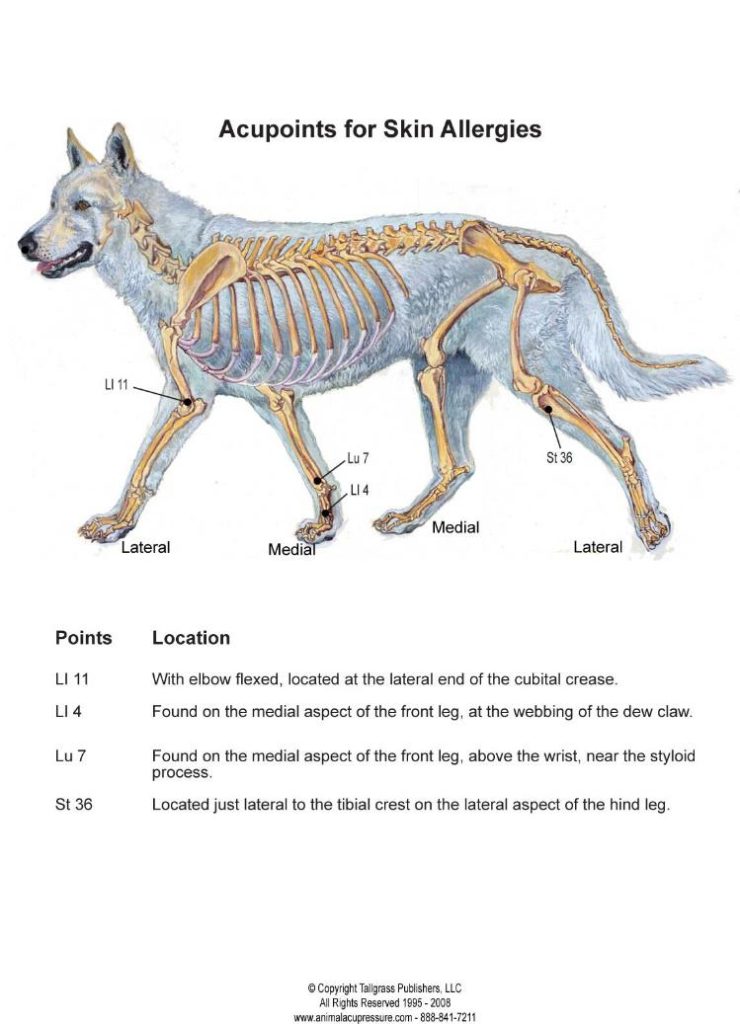
Stimulating these four acupoints every fourth or fifth day can help your dog resolve current reactions and avoid skin allergies in the future. Combine this regime with your wholistic veterinarian’s recommendations, a balanced lifestyle, along with minimizing or eliminating exposure to the offending allergens and you will have gone a long way to making your dog comfortable in his own skin.
Two Acupoint Point Work Techniques
Thumb Technique – while having a hand in a relaxed position comfortably on your dog, place the thumb of your other hand perpendicular to the acupoint shown in Skin Reaction chart and apply about 1 pound of pressure or less depending on the size of your dog. Keep your thumb on the acupoint and count to 20 slowly or until the dog expresses an energy release such as: yawning, stretching, licking, passing air, or even falling asleep. If the dog seems at all distressed or a particular point is painful move on to the next point or please stop and try this acupressure session at another time.
Two-Finger Technique – the two-finger technique is often more applicable for smaller dogs. First, place one hand on your dog where you and the dog are comfortable. Second, place your middle finger on top of your index finger and then apply a pound or less of pressure on the acupoints shown in the chart while counting to 20 slowly or until the dog indicates an energy release: licking, yawning, stretching, passing air, or possibly sleeping. If your dog exhibits any discomfort while a point is being work, move on to the next, or stop and offer this acupressure session at another time.
Amy Snow & Nancy Zidonis are the pioneers in animal acupressure. The founded Tallgrass Animal Acupressure Resources offering you books, online training courses, and meridian charts for dogs, horses, and cats. Check out the Tallgrass website for articles, blogs and other learning resources. Acupressure-massage is safe, always available, powerful yet gentle.
Website: www.animalacupressure.com
Email: tallgrass@animalacupressure.com


