
Hidden in Plain Sight: Is Your Dog Experiencing Microtrauma?

By Dr. Laura Donaldson, PhD, CDBC, KPA CTP.
I want to begin with this seemingly joyful picture of a parent, a young child and their dog playing on the beach. However, while the mother and child show carefree happiness through wide smiles, their dog (a Dalmatian) manifests body language conjuring anxiety, worry and physical discomfort. The dog’s roached back, splayed feet and worried expression plus lip licking are concrete signs of an encounter that is likely causing him both physical pain and emotional trauma—or more particularly, microtrauma. But what, you might ask, is microtrauma, anyway?
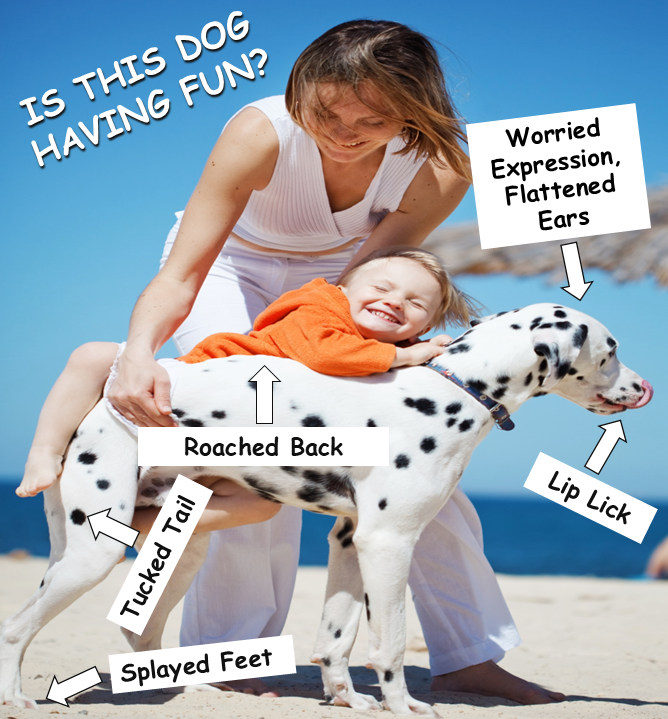
Text & graphic annotations, Dr. Laura Donaldson; Photo Credit: Shutterstock
I define trauma broadly as an experience overwhelming a subject’s capacity to cope. It is critical to note that trauma results from our response to an experience and is not an inherent characteristic of the experience itself. In contrast to macrotrauma where dogs are responding to single events like off-leash dog attacks or natural disasters, microtrauma conjures responses to “smaller scale, repetitive interactive events which are often hidden in plain sight” (Crastnopol, 2015). Crastnopol, a psychiatrist, describes this process as “little murders and other everyday micro-assaults.” This essay’s opening scenario of a family playing on the beach exists as a vivid example of this. Interactions with children like ear/tail grabbing, routinely violating the dog’s safety boundaries, teasing and inappropriately restraining the animal (e.g., children tightly hugging dogs) frequently pose microtraumatic risks. Other potential culprits include subjecting the dog to overwhelming situations (the dog park comes immediately to mind here); use of punishment and other aversive techniques like yelling or physical force (dragging a dog into a crate or confined space, for example); and deprivations like neglect as well as chronic social isolation (dogs living in the backyard). These experiences often cause dogs to respond with adaptive survival strategies like barking, growling and biting and behavioral shutdown.
Dr. Bruce Perry (2017) notes that “over time the physiological and psychological effects of many small, uncontrollable stresses can be remarkably like those we associate with more extreme experiences. The pattern and context of stress system activation—i.e., whether it is controllable or not, whether it occurs predictably or not—is as important as the intensity of the activation.” While microtrauma does not possess the concentrated power of single event trauma, its cumulative effect on a human or canine subject’s stability, safety and general emotional well-being can be just as devastating.
How can you tell if your dog is experiencing microtraumatic stress? Dogs and humans have closely parallel social and emotional brains and, as veterinary behaviorist Dr. Carlo Siracusa (2018) notes, “a similar brain also means sharing similar behavior problems.” I would add that it also means sharing similar responses to trauma. Both dogs and humans struggling with microtrauma are likely to exhibit generalized anxiety, increased hypervigilance, avoidance (of certain people/places/situations), disturbed sleep, fear of being alone, decreased interest in a favorite activity or aggressive behavior (Teller 2020). In future blogs I will address best practices of responding to these issues so stay tuned! Next month, for example, I will be exploring why “Traumatized Dogs Need Empathy Not Control.” In the meantime, be your dog’s emotional support human by listening to them, loving them and always, keeping the canine faith!💕🐾❤
Dr. Laura Donaldson, PhD, CDBC, KPA CTP, CCUI is a Professor Emeritus from Cornell University located in Ithaca, New York, northeastern United States. She is an award-winning writer on dog behavior who has worked as a canine behavior specialist for 20+ years. Laura is a Certified Dog Behavior Consultant (CDBC), a Karen Pryor Certified Training Partner (KPA CTP), a Certified Trauma Professional and created the popular program, Slow Thinking is Lifesaving for Dogs®. When she isn’t speaking, teaching or writing, you will find Laura partnering with her working Border Collies to tend her flock of Navajo Churro sheep. Check out her online webinar, “Why Becoming Trauma-Informed Will Change Everything You Do With Dogs” at https://laura-s-school-1f3f.thinkific.com/courses/why-becoming-trauma-informed-will-change-everything-you-do-with-dogs.
References
Crastnopol, M. (2015). Micro-trauma: a psychoanalytic understanding of cumulative psychic injury. Routledge, Taylor & Francis Group.
Perry, B. (2017). The boy who was raised as a dog: and other stories from a child psychiatrist’s notebook: what traumatized children can teach us about loss, love, and healing (2nd ed.). Basic Books.
Siracusa, C. (2018). Dogs and humans have similar social and emotional brains. https://www.psychologytoday.com/us/blog/decoding-your-pet/201806/dogs-and-humans-have-similar-social-and-emotional-brains
Teller, L. (July 16, 2020). Caring for a dog with PTSD. CVMBS News. https://vetmed.tamu.edu/news/pet-talk/caring-for-a-dog-with-ptsd/


