
TROOPER CAN FLY: With Acupressure Help
By Amy Snow & Nancy Zidonis.
Trooper, an older Greyhound, was given his favorite Kong filled with peanut butter in exchange for lying down in his crate in a very noisy and confusing building at the airport. His guardians were trying to stay calm, but they were obviously tense and worried. Luckily, Sarah, Trooper’s mom, had taken a canine acupressure course and remembered a few specific acupressure points that she could hold to help Trooper be more comfortable flying from Los Angeles to Denver where they were going to vacation in the Rocky Mountains.
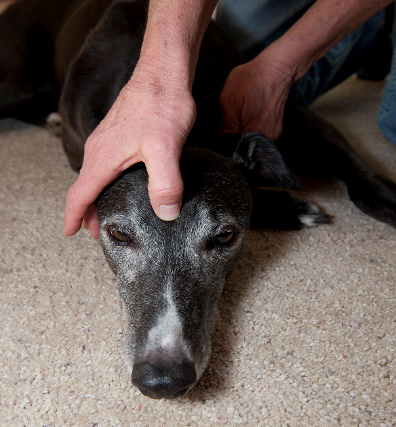
Realizing that Trooper was too unsettled to even pay attention to the Kong, Sarah let him out of the crate and sat on the floor with him. She then placed the soft tip of her thumb just above and between Trooper’s eyes in the “third-eye” position. This point is called the Yin Tang point and is used to help dogs become more focused and feel calm. Sarah rubbed that point for a slow count to 20.
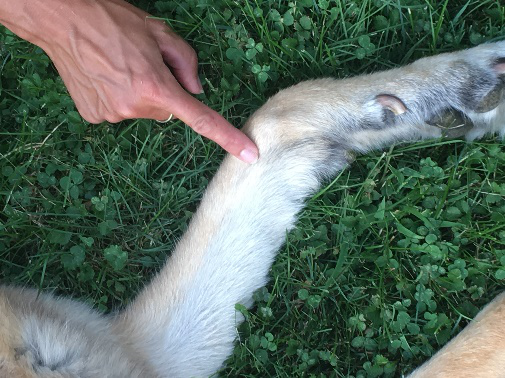
Continuing her mini-acupressure session, Sarah held and pressed her thumb on the webbing of Trooper’s dewclaw, that the point called Large Intestine 4. This point is known to soothe the mind and relieve anxiety. After this brief acupressure session, Trooper was less stressed and more willing to settle in his crate and enjoy the ride.
Animal guardians and medical practitioners are becoming more aware of the fact that conventional veterinary care is finally catching up with ancient the ancient healing arts. Both approaches to medicine are so powerful and so necessary to assure the optimal health for our animals. Modern medicine has developed excellent diagnostic tools, surgical procedures, and methods of dealing with trauma that are of great benefit to us all. Traditional Chinese Medicine (TCM), through thousands of years of clinical observation, is highly proficient at treating both acute and chronic illness, musculoskeletal conditions, and behavior issues.
The ancient healing sciences strive to maintain the harmonious balance of the body’s vital energy, called Chi (pronounced “Chee”, also written as Qi), so that the body, canine or human, can heal itself. When there is an imbalance caused by emotional stress or muscles soreness after agility training, animal guardians, with just a basic knowledge of acupressure, can help their dogs feel better and heal. Acupressure is not a substitute for regular veterinary care, we recommend seeing your vet if you have any questions about your dog’s condition.
Because acupressure is safe, drug-free, non-invasive and extremely powerful, it gives people the opportunity to participate in their dog’s overall health, well-being, and enjoy the flight!
Amy Snow and Nancy Zidonis are the authors of ACU-DOG: A Guide to Canine Acupressure, ACU-CAT: A Guide to Feline Acupressure, and ACU-HORSE: A Guide to Equine Acupressure. They founded Tallgrass Animal Acupressure Resources, which offers books, manuals, online training courses, DVDs, apps, meridian charts, consulting, and many more acupressure learning tools and opportunities.
Email: tallgrass@animalacupressure.com
Website: www.animalacupressure.com


