
The “Leash Greeting” Drama: Why Forced Small Talk is Barking Up the Wrong Tree
By iKE ALLEN, Happy Healthy Dog Co-Founder
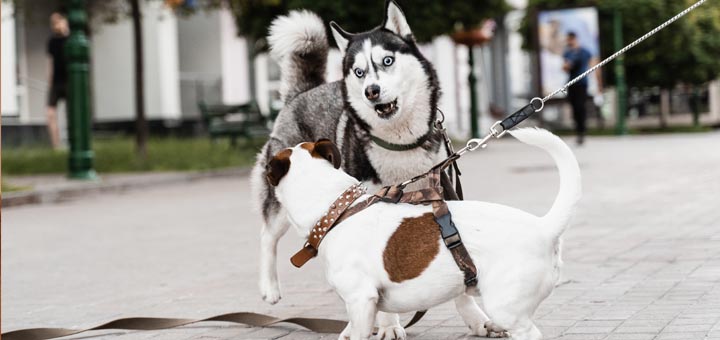
If you’ve ever walked a dog on a sidewalk, you know the “Leash Greeting” dance. You see another owner approaching, both dogs start pulling, and suddenly you’re in a tangled mess of leashes while the dogs go nose-to-nose.
Of all the dogs I’ve been fortunate to have in my life, my dog Maia was a super lover of this type of “socializing.” But for many dogs, a head-on greeting on a tight leash is terrifying. They are physically restrained, they can’t use their natural body language to curve or sniff, and they have no “escape route.” It’s high-pressure, high-stakes, and it often leads to a bark or a snap simply because the dog feels trapped in a situation they didn’t choose.
The Dog Education: The Power of the Parallel Walk
In dog training, they prefer the Parallel Walk. Instead of forcing dogs to meet face-to-face, they have both owners walk in the same direction, twenty feet apart. The dogs get to see each other, scent each other, and “share” an activity without the pressure of a direct confrontation. Once they’ve spent ten minutes walking together, they naturally relax. They’ve built a “connection” without the “collision.”
If you have a super social dog like Maia was, you need to remember not every dog is the instant life of the party.
The ReThink Pivot: Desperation, Obligation, or Inspiration?
Humans are the only animals that force themselves into “Leash Greetings” every single day. We call them high-pressure networking events or awkward social gatherings where you’re expected to stand nose-to-nose with a stranger and “perform.”
Years ago in my LEAP! Seminars, I used to teach a concept that fits perfectly here: Are you coming from Desperation, Obligation, or Inspiration?
Most forced social interactions are fueled by Obligation (“I should be here”) or Desperation (“I hope they like me”). When you’re on that “short leash” of pleasing others, you aren’t really connecting; you’re just performing. A lot of people eventually realize that life isn’t about managing other people’s expectations of you. It’s about learning to do what feels right for you.
When you shift to Inspiration, you stop forcing the “nose-to-nose” collision. You realize you don’t owe anyone a high-pressure performance. Instead, you look for the “Parallel Walk”—finding people who are moving in the same direction as you, where the connection happens organically because you’re both inspired by the same path.
Using the ReThink Method allows us to realize the most important “Good job!” is the one that comes from inside. When you stop judging yourself for choosing your own pace, you discover that the most meaningful relationships aren’t “forced”—they are found. You become a “self-rewarding” pup who knows that the best pack members are the ones you enjoy walking beside, not the ones you feel obligated to tangle with.
The [ReThink] Tool: The LEAP! Check
The next time you’re feeling the pressure of a “nose-to-nose” social situation, do a quick internal audit:
- Identify the Energy: Ask yourself: “Am I here out of Obligation, Desperation, or Inspiration?” If it’s the first two, your internal leash is too tight.
- Find the Parallel Path: If you’re feeling trapped, change the geometry. Instead of a direct “interview-style” conversation, suggest an activity. “Let’s walk while we talk,” or “I’m going to go look at that exhibit/booth, want to join me?”
- The Inspiration Reward: Give yourself a “Good job!” for choosing what feels right for you. Notice how much easier it is to breathe when you aren’t trying to please the whole park.
The Bottom Line
Connection shouldn’t feel like a chore.
If a situation feels too forced, give yourself permission to step back and find a parallel path. Whether you’re a dog or a human, the best friendships aren’t built in a head-on collision; they’re built while walking the same path, inspired by the same view, with plenty of room to just be.


I appreciate these insights, both dog and human. I also had a friendly dog who loved greeting other dogs. I never realized a simple shift of movement would benefit the other dogs. And now I’m going to try to shift my interactions from obligation to inspiration!
I agree, Toni, and am so glad you are moving towards inspiration! Hopefully that will spread to other people too. I just interviewed Steve Dale, an animal behaviorist who reminds us to ASK THE DOG what it wants. Even when you come from inspiration with the person, keeping checking out what their dog, and yours, wants. it is a children’s book I would love to see read to every child.