
From “Box-Shy” to Bold: How Twinkles Taught Us to Rewrite Dog Trauma
By iKE ALLEN, Happy Healthy Dog Co-Founder
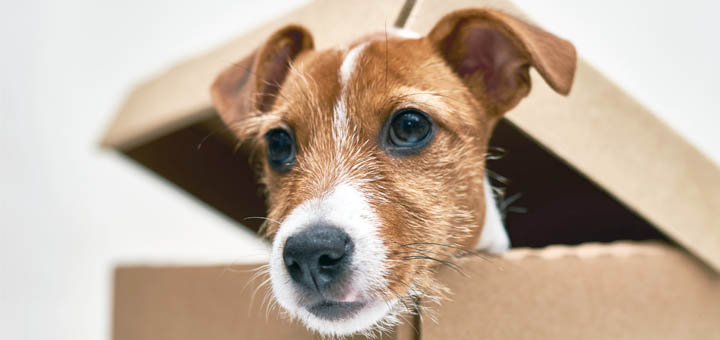
We’ve all been there: one minute your dog is a confident explorer, and the next, they’re cowering at a random household object. For my childhood family dog, Twinkles, the “monster” was a simple cardboard box.
My father suspected a box may have tipped off a shelf and spooked her when no one was looking. Suddenly, this once-brave little dog wouldn’t go near a package. It felt like her personality had shifted overnight. But through Twinkles, I learned one more powerful lesson that would eventually lead me to the foundation for my brand, ReThink: Trauma doesn’t have to be permanent.
If your dog has developed a sudden, “irrational” fear, here’s the science of why it happens and how you—like we did—can help them rewrite their story.
The Science of the “Spook”: Why Dogs Remember
Unlike humans, dogs don’t create complex “narratives” about their trauma. They don’t think, “I’m a clumsy dog,” or “The ceiling is falling.” Instead, they are masters of associative learning.
When that box hit Twinkles, her brain made a lightning-fast connection:
- The Stimulus: A box.
- The Result: A loud noise and a physical shock.
- The Conclusion: Boxes = Danger.
This is a survival mechanism. In the wild, if a rustling bush precedes a predator, a dog’s life depends on remembering that “rustle” means “run.” In your living room, that same survival instinct can turn a delivery box from JCPenney, into a terrifying foe.
Cognitive Distortions (Doggy Edition)
While dogs don’t “overthink,” they do generalize. This is the canine version of a cognitive distortion. If one brown box falls, a dog might decide that all boxes—regardless of size or color—are out to get them. If left unaddressed, this fear can “fossilize,” making the dog more cautious in their everyday life.
The “Chicken-in-the-Box” Strategy: How We Healed Twinkles
To help Twinkles, we didn’t force her to face her fear. Instead, we used Counter-Conditioning. We wanted to physically rewire her brain’s emotional response from “Fear” to “Joy.”
Here was our process:
- The High-Value Trade: We ditched the standard dry kibble and brought out the “big guns”—pieces of fresh, cast iron fried chicken. (I still have my dad’s cast iron frying pan today)
- Creating Agency: We placed a box on the floor and scattered the chicken inside. We didn’t push her toward it; we let her decide when the reward outweighed the risk.
- Rewriting the Memory: Every time Twinkles took a step toward the box and got a piece of chicken, her brain released dopamine. Slowly, the old “Fear” circuit was overwritten by a new “Reward” circuit.
By the end of the week, Twinkles wasn’t just “tolerant” of boxes—she was diving into them with her tail wagging!
You Can Help Your Dog Bounce Back
The most heartening part of Twinkles’ story? She stayed bold. Because we intervened early and used positive reinforcement, she didn’t become an overly cautious dog. She learned that even when the world is scary, she has the tools (and the human companions) to navigate it.
If your dog is struggling with a new fear, remember these three tips:
- Find their “Jackpot”: Use a treat they never get otherwise (chicken, cheese, or steak).
- Respect the “Threshold”: If your dog is shaking, you’re too close. Move the scary object further away until they can eat comfortably.
- Be Patient: You aren’t just training a command; you’re healing a nervous system.
At the end of the day, helping your dog navigate a traumatic event is about more than just “training”—it’s about helping them ReThink their environment so they can live their happiest, healthiest life.


