
Canine Depression: Rebounding with Acupressure
By Amy Snow & Nancy Zidonis, Tallgrass Animal Acupressure Resources.
Jazz just isn’t herself. Jazz is a 4-year-old Labrador-Standard Poodle mix with energy galore. Her guardians had to take her out for a vigorous run or have her dash around the dog park with her buddies at least twice a day to keep her from bouncing off the walls at home. Up until a month ago, Jazz lived to play with any dog or human who came her way.
Jazz’ guardians are baffled. Where did their happy, athletic girl go? The jingle of her leash is met with little enthusiasm. She looks at them with this resigned look that says, “Okay, if you really must, I guess I’ll get up and take you for a walk.” A full food bowl used to be two exciting moments in her day, now she looks at it, takes a bite or two and goes back to her bed to sleep.
It’s time to take Jazz to the holistic veterinarian for a check-up. The first step to figuring why Jazz’ behavior has changed so radically in the past month is to make sure there are no physical health issues. A dog experiencing pain will decrease her activity. There are many underlying physical issues which can lead to Jazz’ loss of zest for life.
Once a medical condition is ruled out, Jazz’ guardian needs to think back to anything that may have happened a month or so ago when Jazz’ behavior began to change. Oh my, that’s when their son left for college. The first week after he left, Jazz looked for him all over the house and sat next to the door waiting for him to come home. As the days went on, she slept more and lost interest in playing, eating, and socializing. Jazz slowly slid into a deeper and deeper depression.
Canine Depression
Dogs experience depression much the way we do and for similar reasons. There are a host of reasons and the most common are loss of a companion animal or person, moving to a new house, changing the dog’s schedule, loneliness, not getting as much attention when a newcomer arrives, a crisis occurs in the household, plus reacting to the guardian’s depression. Other canine depression triggers include abuse, neglect, pain, aging, and even seasonal shifts.
The most common indicators of canine depression are excessive sleeping, minimal or no interest in play or exercise, either loss of appetite or overeating, generally low energy level, withdrawn, tucked tail, dull eyes, and peeing or pooping in the house. Some dogs can become agitated and restless when depressed and cannot be comforted or calmed. The main thing to watch for is a change in behavior whether it’s sudden or takes place gradually.
After your holistic veterinarian has not found a medical explanation for the change in your dog’s behavior, there are many things you can do to help your dog rebound from his depression.
Canine Acupressure & Behavioral Techniques
Most dogs pull out of their slump in a short time on their own. However, there are dogs that have trouble bouncing back after sliding into a depression. These dogs are suffering, and they need help.
Acupressure can bring renewed vitality to your dog. Whether he is grieving a loss or bewildered by changes in his life, his behavior indicates he has lost his vitality. In Chinese medicine, chi, life-promoting energy, can become blocked and stagnant when the animal is sad. By stimulating specific acupressure points, also called “acupoints,” you can revitalize the flow of chi throughout his body which, in turn, can re-energize his emotional wellbeing.
It can take a few acupressure sessions to see the effects of working with acupoints known to enhance and restore the harmonious flow of chi especially when your dog has been experiencing depression for a long time. The added benefit of giving your dog an acupressure session is you are giving him the attention he really needs. If there have been changes in the members of your “pack” that’s triggered his depression, being the agent of his revitalization is important.
Along with offering your dog acupressure sessions, canine behaviorists offer a lot of good suggestions for helping your dog overcome depression. Providing extra attention by playing with your dog, going for walks, heading out to the dog park for more canine socializing are ways to get your dog going again. The more exercise you can give him, the better his vital chi energy will be. Dogs like routine, be sure to maintain as consistent an eating and exercising schedule as you can. When he shows more interest in activity, be sure to reward him.
Be careful not to reward his depressed inactivity. You can snuggle and love your dog because that’s good for both of you but try not to link his sad behavior in a way he could get the idea you are rewarding him for it.
Dogs are fun-loving creatures. With patience and love, you can bring your special dog back to being to his naturally happy, energetic self with a little help from canine acupressure.
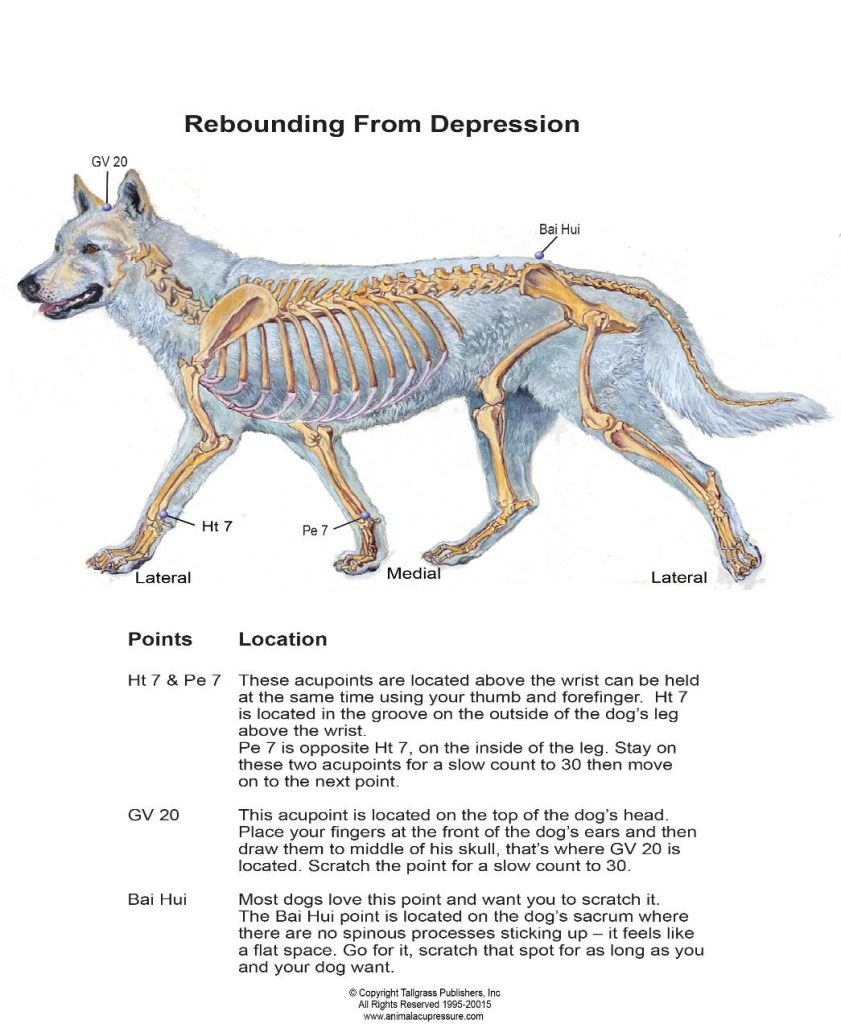
Heart 7 ( Ht 7) & Pericardium 7 (PE 7) – These acupoints are located above the wrist can be held at the same time using you thumb and your forefinger. Ht 7 is located in the groove on the outside of the dog’s leg above the wrist . Pe 7 is on the opposite side, on the inside of the leg. Stay on those two acupoints for a slow count to 30 then move on to the next point.
Governing Vessel (GV 20) – This acupoint is located on the top of the dog’s head. Place your fingers at the front of the dog’s ears and then draw them to middle of his skull, that’s where GV 20 is located. Scratch the point for a slow count to 30.
Bai Hui – Most dogs love this point and want you to scratch it. The Bai Hui point is located on the dog’s sacrum where there are no spinous processes sticking up – it feels like a flat space. Go for it, scratch that spot for as long as you and your dog want.
Acupressure offers you and your dog thousands of years of health and wellbeing. It’s safe, always available, and gentle yet powerful. Tallgrass has all the resources you need to learn and apply canine acupressure-massage. There’s an Online Training program especially for dog guardians, plus, ACU-DOG: A Guide to Canine Acupressure book, Meridian Charts, Apps, and a website with articles and blogs to get started here. Email: tallgrass@animalacupressure.com


