
If You Live or Work With Dogs Having Big Feelings, You Have Probably Heard of Trigger Stacking . . . Hello TRAUMA STACKING
By Dr. Laura Donaldson, PhD, CDBC, KPA CTP.
If you live or work with dogs having Big Feelings, you have probably heard of trigger stacking. This concept is useful because it captures the dense complexity and layering of experience which is too often smoothed over by a generic “reactive dog” label. As Jean Donaldson (2013, no relation) notes, “triggers can be added together. Combinations of more than one trigger at the same time usually evoke a higher level of threat . . . Some novel combination of elements pushes the dog higher than the elements on their own have ever pushed him previously.” But one might ask, how does this work in real life? Let’s say you take your dog out for a walk around the block and you immediately encounter the neighbor’s cat. Fortunately, your dog—who often barks at the neighbor cat—manages this encounter calmly. However, halfway down the block, a fast-moving bicycle passes you which causes an escalation of your dog’s stress levels. You know this because you notice the piloerection (hair standing up) on the back of his neck as well as the increase in muscle tension around his mouth. After you make the final turn for home, a large dog with a fierce bark runs down from someone’s porch and begins fence fighting with your dog as you walk along the sidewalk. This final encounter overwhelms your dog’s capacity to cope and activates what one might describe as a hyperarousal/hypervigilance meltdown: pulling strongly on the leash as well as barking and lunging toward the intruder dog. This is how trigger stacking can turn even a simple around-the-block walk into a stressful experience. It is also an analogue for how trauma stacking works for canine survivors.
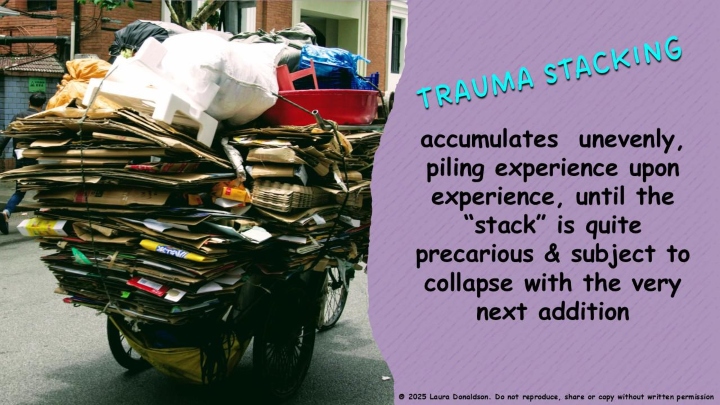
In one of the earliest references to this process, Gail Johnson (2016) suggests that “when it comes to stacked trauma, it helps to think visually.” My visual thinking prompted this article’s opening image of an overloaded cart with jumbled contents secured by the flimsiest of cords. This visual graphic depicts how trauma accumulates unevenly, piling incident upon incident until the “stack” is quite precarious and subject to collapse with the very next addition. Similarly, traumatic experience in dogs frequently combines not only macrotrauma like an off-leash dog attack but also microtrauma (see my earlier article on this here) not only single-event but also cumulative stressors. This counters the tendency to flatten trauma as a “one and done” phenomenon which is devastating but finished and in the past. The concept of trauma stacking renders a more accurate and fully embodied scenario of what actually happens for survivors. For example, this is what it looked like for Rain (not her real name), a nine-month-old Labrador Retriever mix who is a former behavior client of mine.
Trauma #1: A history of maternal deprivation and forcible removal from the litter at four weeks of age. Rain was abruptly taken from her litter when her mother tried to kill several pups. We know that in humans, severe maternal neglect can cause extreme developmental delays, depression and even death. Indeed, even “lesser degrees of neglect are associated with the subsequent development of aggressive behaviors (van der Kolk, 2003).” Just as in humans, severe maternal stress can also render puppies vulnerable to a lack of resilience as well as significant emotional dysregulation later in life.
Trauma #2: When she was 6 months old, Rain broke a front toe at dog day care which subsequently resulted in three months’ confinement except for short trips outside to toilet. This level of physical restriction was highly stressful for her. In addition, it compromised her ability to interact with the environment during a key developmental period.
Trauma #3: Another dog attacked Rain while she was still in the leg cast. Although she did not sustain any serious physical injuries from this incident, Rain’s humans immediately observed a change in her behavior: “She began to bark and lunge at strange people and dogs. She never behaved this way when meeting people she had seen at a younger age.”
Trauma #4: Rain’s humans implemented a vigorous post-attack “behavior modification” program before Rain was ready for this. The end result of this program was multiple bites to a household visitor recruited to come and help “socialize” Rain. After this incident, Rain’s humans were seriously considering behavioral euthanasia. They thankfully decided to call me instead.
Research about human adolescents has determined that the accumulation and combination of multiple stressors predictably leads to more severe outcomes (Suliman et.al., 2009). We also know that someone who has experienced previous trauma—especially if it is violent—is more likely to develop post-traumatic stress from subsequent traumatic events. There is an even greater risk of this if the earlier trauma happened during childhood. This has resonance for Rain as well since her trauma began exceedingly early with a difficult litter experience and then continued several months later with physical (a broken toe) as well as emotional (attack by another dog) contributions. So, one might ask, what does Rain’s accumulation and combination of traumatic stressors teach us and how can it help us attend more compassionately and knowledgeably to the dogs in front of us?
While there are multiple takeaways from the concept of “trauma stacking,” the most important is reappraising traumatic stress more continuously and complexly than the usual “one and done” characterization allows. This would significantly influence how one assesses behavior issues in dogs. For example, early litter experiences would (and should) become an urgent, obligatory part of a dog’s complete history. A second takeaway would be to acknowledge that the impact of previous trauma does not diminish over time (Khiron Clinics, 2024). Instead, it is an always existing experiential layer potentially complicating a canine trauma survivor’s goal of healing—and programs promoting healing from trauma should consider past as well as present injuries to provide maximum benefit.
Finally, whether in humans or dogs, trauma can often be messy. It is unpredictable and never linear but devastating, nonetheless. My goal in highlighting and unpacking the concept of trauma stacking in this essay is to help those living or working with trauma survivors—as well as the survivors themselves—understand their injuries more fully and because of this, enable more complete healing.
*I define a trigger as any stimulus to which a dog reacts intensely, whether the stimulus is visual or aural, a discrete entity or an experience.
Dr. Laura Donaldson, PhD, CDBC, KPA CTP, CCUI is a Professor Emeritus from Cornell University located in Ithaca, New York, northeastern United States. She is an award-winning writer on dog behavior who has worked as a canine behavior specialist for 20+ years. Laura is a Certified Dog Behavior Consultant (CDBC), a Karen Pryor Certified Training Partner (KPA CTP) and a Certified Trauma Professional. She created the popular program called Slow Thinking is Lifesaving for Dogs®. Laura currently resides in upstate New York with her husband, two dogs, three cats, and an African Gray Parrot named Obi. When she isn’t speaking, teaching or writing, you will find Laura partnering with her working Border Collies to tend her flock of Navajo Churro sheep. https://fourpawsfourdirections.com
REFERENCES
Donaldson, J. (2013). The culture clash (new second ed). The Academy for Dog Trainers.
Johnson, G. (2016). Stacked Trauma. https://fountainhillcenter.org/traumastack/
Khiron Clinics (2024). Previous trauma increases the risk of ptsd from additional trauma. https://khironclinics.com/blog/previous-trauma-additional-trauma/
Khiron Clinics, 2024. “Previous trauma increases the risk of ptsd from additional trauma.” https://khironclinics.com/blog/previous-trauma-additional-trauma/
Suliman, S., Mkabile, S., Fincham, D., Ahmed, R., Stein, D. & Seedat, S. (2009). Cumulative effect of multiple traumas on symptoms of posttraumatic stress disorder, anxiety, and depression in adolescents. Compr Psychiatry, 50(2), 121-127.
van der Kolk, B. (2003). The neurobiology of childhood trauma and abuse. Child and Adolescent Psychiatric Clinics of North America, 12(2), 293-317.


What would cause a Dam to try to kill several of her puppies?
And how does one prevent this from happening again?
Terri, it can be a number of things. Maternal stress; a dam who is herself traumatized and lacks the coping skills to nurture a litter of pups; failure to bond and so on. It is tragic but happens much more than you might think.
Highly educational article. It is critical that all of us, dog companions, are aware of all these ‘nuances’.
Nuno, many thanks for the good words!